
35 states report COVID-19
As of Monday, March 9, the Colorado Department of Public Health and Environment reported 12 presumptive positive cases of COVID-19 in the state.
Colorado joins 34 other states, including the District of Columbia, that have reported cases to the Centers for Disease Control and Prevention. On Monday, the CDC website said the U.S. has 423 total cases and 19 deaths. The data includes both confirmed and presumptive (tested at the state level) positive cases since Jan. 21.
Over 100 countries have cases of COVID-19, as reported by the World Health Organization to the CDC.
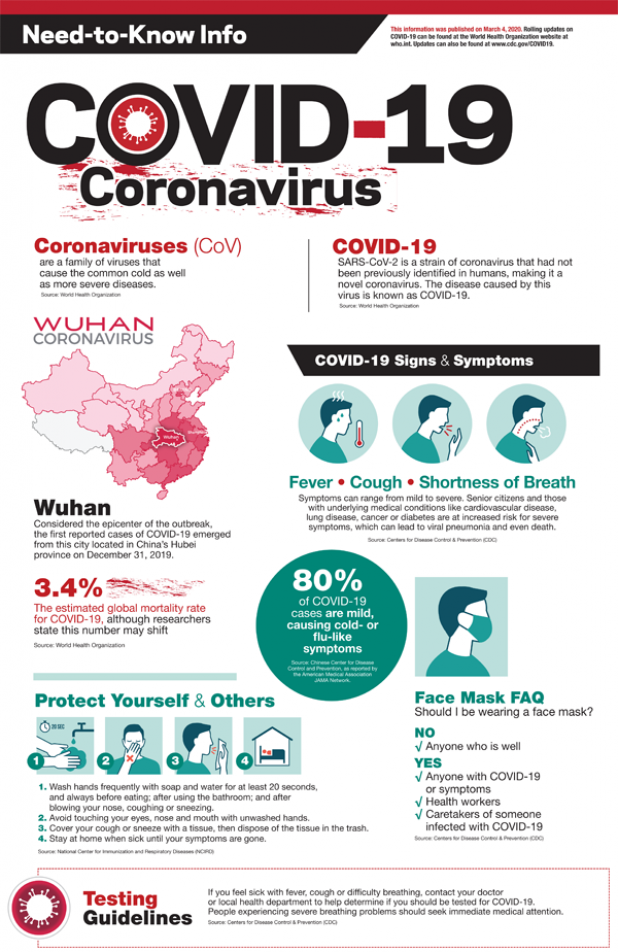
The respiratory disease caused by a novel (new) coronavirus was first detected in China Dec. 31, 2019. The city of Wuhan in China’s Hubei Province is considered the epicenter of the outbreak.
The virus has been named SARS-CoV-2, and the disease it causes has been named coronavirus disease 2019, abbreviated COVID-19.
Symptoms including fever, cough and shortness of breath may appear two to 14 days after exposure. Reported illnesses have ranged from very mild to severe, including illness resulting in death. CDC said that information so far suggests that most COVID-19 illness is mild. Older people and those with underlying health conditions, such as heart disease, lung disease and diabetes, seem to be at higher risk of developing serious illness.
Melissa Memorial Hospital in Holyoke said that if anyone has the above symptoms, they should call the Family Practice of Holyoke at 970-854-2500 to discuss a care plan before going to the hospital or the emergency room. MMH would consider sending an on-staff community paramedic to do the testing to lessen the strain on the patient as well as contain the possible infection.
7 Colorado counties have presumptive positive cases
Out of the COVID-19 tests in Colorado, 12 were presumptive positive, one was indeterminate (treated as a positive) and 284 were negative, as reported by CDPHE on March 9.
CDPHE reported Colorado’s first case March 5. An out-of-state man in his 30s was visiting Summit County. He was exposed during international travel or through contact with an out-of-state case.
Arapahoe County has one case of a woman in her 30s, and Larimer County has one case of a woman in her 50s.
Denver County’s three cases include a man in his 40s, a woman in her 70s who was exposed during international travel and a woman in her 30s with recent U.S. travel history but no known contact with an infected person. Denver County also has one indeterminate case of a woman in her 70s.
Three cases in Douglas County are a school-aged female, a woman in her 40s and a woman in her 70s. All were exposed during international travel.
Eagle County’s two cases are a woman in her 50s who was exposed during international travel and a woman in her 70s who has recent U.S. travel history.
El Paso County has one case of a man in his 40s who has recently traveled in the U.S.
How to stop the spread
Health agencies in Colorado and other states are working diligently to limit and slow the potential spread of COVID-19.
The disease most likely spreads the same way as similar respiratory illnesses. Person-to-person contact includes being within 6 feet of someone with a confirmed infection for a prolonged period of time or through respiratory droplets from coughs or sneezes. It is also possible to get COVID-19 by touching a surface or object that has the virus on it and then touching one’s mouth, nose or eyes.
Community members are reminded to frequently wash their hands, cover coughs and sneezes, avoid touching the face with unwashed hands, stay home if you’re sick, and clean surfaces in the home and personal items, such as cellphones.
While some communities in the U.S. have asked people to stay home from work, school and other events to help stop the spread, most places have not asked for any restrictions.
Community members should stay informed, and those who are traveling internationally should check travel info before departing.
For answers to questions, call the CO HELP: COVID-19 Hotline at 303-389-1687 (English and Spanish) or email COHELP@RMPDC.org (English).
For up-to-date Colorado information, visit www.colorado.gov/cdphe/2019-novel-coronavirus.
For more information from the CDC, visit www.cdc.gov/coronavirus/2019-ncov.