
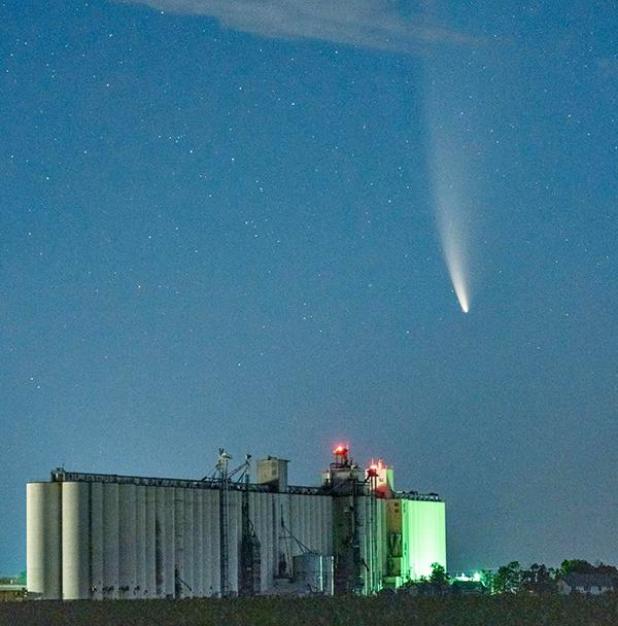
Capturing this photo of Comet NEOWISE over the Amherst elevators was no small feat for Bob Leben. Situated on a dirt road south of the elevators with a high-end rental camera, he captured the image July 13 at 3:35 a.m. while most people were comfortably in bed. — Bob Leben
With astrophotography, Bob Leben shows Amherst in a different light
Bob Leben first photographed a comet in 1976. He was a senior at Holyoke High School, shooting film and working on a science fair project. Mind you, that wasn’t the first time he’d seen a comet. That happened between his junior and senior years. He was at the Frontiers of Science Institute in Greeley taking a look at Ursa Major when he spotted one. Unfortunately it had already been discovered, so it didn’t go down in history as Comet Bob.
Fast forward to 1976, and Comet West was a visible presence in the sky. Leben recalls seeing it from a bus window while going on a ski trip, and to this day, it’s the brightest comet he’s seen. He decided to photograph Comet West for the local science fair.
A mistake he made in the developing process meant he didn’t have an actual photo for the fair, but judges decided that his project would still be worthy of a trip to the regional science fair if he could successfully capture and develop a photo. In the end, he did, and he received regional and state honors for doing so.
This summer has once again found Leben out at all hours of the night photographing a comet. Officially named Comet C/2020 F3, it’s also known as Comet NEOWISE. It was detected March 27 by NASA’s space-based telescope NEOWISE (near-Earth object wide-field infrared survey explorer).
It’s rare for comets to be visible to the naked eye, but this summer, folks in the Northern Hemisphere have been embracing the chance to catch a glimpse of Comet NEOWISE while they still can. It will, after all, be some 6,800 years before it returns. Even the chance to casually see a different comet may not happen for a while. The last one this bright was Hale-Bopp back in 1995-1996.
Leben has long been a photography enthusiast, but when it came time to choose a career path, he figured he was better off being an engineer that dabbled in photography rather than a photographer that dabbled in engineering.
He earned his bachelor’s, master’s and doctorate degrees in aerospace at University of Colorado Boulder. Having spent his entire career working at his alma mater, Leben is now semiretired. One of the perks of retirement is more time to focus on photography — specifically astrophotography.
Sometimes he shoots photos from near his home in Boulder, but the family farm offers an irresistibly dark night sky.
Leben grew up just outside of Amherst. His parents, Gordon and Winona, lived 2 1/4 miles straight east of the elevators. Though the couple lives in Holyoke these days, Leben still makes it out to the farm fairly often. There he’s captured mesmerizing photos that showcase both the night sky and this little corner of Colorado.
Of course, the experience these days varies slightly from that of the ’70s. Back when he was shooting film, there was a lot of crossing his fingers and hoping for a good outcome when the time came to develop the photos. With digital photography, he has immediate feedback. With social media he can provide a view of the world that many would otherwise never see.
Earlier in the month, Comet NEOWISE was only visible in the early morning before sunrise. That didn’t stop Leben from trekking out in the middle of the night, but more casual observers are in luck. The comet can now be seen after sunset.
If you’re planning to catch a glimpse, head a couple of miles out of town to get away from the lights. Once it’s dark, look to the northwest. This week, you should be able to see it just below the Big Dipper early in the night. Throughout the night, it will dip below the horizon and later be visible to the northeast.
To the naked eye, the comet might barely be visible. It looks like a fuzzy star with a faint tail. A pair of binoculars should help you get a better look, and Leben offers this tip: Don’t look directly at the comet. You’ll see it better with your peripheral vision.
Most importantly, don’t wait. Comet NEOWISE isn’t expected to be visible for much longer, and you don’t want to miss it.