
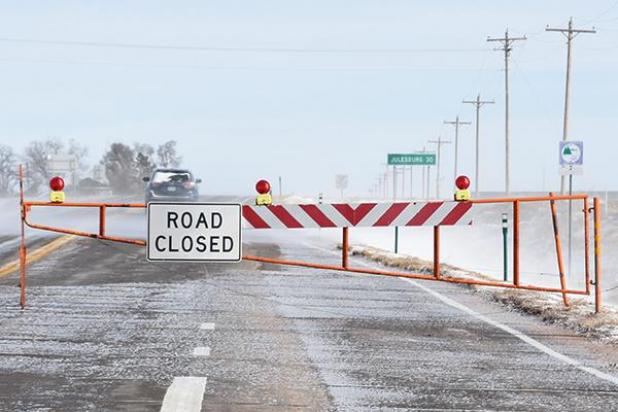
All highways in Phillips County were closed from Wednesday afternoon to Thursday afternoon last week, as a result of the March 13-14 storm that swept through. That didn’t, however, stop some motorists from driving around the barricades. — The Holyoke Enterprise | Johnson Publications
Bypassing barricades puts rescuers at unnecessary risk
Forecasts and warnings gave most people plenty of notice that last week’s storm was coming. By Tuesday evening, many had stopped by the grocery store for supplies and Holyoke School District had canceled school in preparation for a doozy of a blizzard.
Nevertheless, when the storm actually hit, a number of people found it necessary to ignore highway closures and drive around barricades. As a result, Phillips County Sheriff’s Office was called out for multiple rescues throughout the March 13-14 storm.
Holyoke didn’t end up seeing the kind of weather that people had been warned to expect. Wednesday morning was rainy, and even when the temperature dropped and the wind picked up that afternoon, there wasn’t heavy snowfall. Perhaps that’s what gave some the impression that it was safe to be on the roads.
Phillips County Emergency Manager Bob Heldenbrand, who had activated the emergency operations center at 7:45 a.m., said that his first clue that the area may have trouble on the roads came around 10 a.m. when Nebraska State Patrol announced that I-80 westbound would be closed at Ogallala, Nebraska. He and others monitoring the situation were prepared for motorists taking alternate routes that might lead through Phillips County.
Just an hour later, I-76 was closed in both directions from Lochbuie to the Nebraska state line. By 2 p.m., all four highways that pass through Phillips County were closed, though snowfall had yet to reach Holyoke.
As highways remained closed for the next 24 hours, there were many drivers who simply went around the barricades, causing problems for others. For the most part, Heldenbrand said, locals were good about staying where they needed to be. As Sheriff Thom Elliott explained, some of the issues came from out-of-town drivers following GPS directions down county roads.
Starting Wednesday night and continuing into early Thursday afternoon, the EOC and Phillips County Sheriff’s Office were involved in multiple rescues of stranded motorists. Heldenbrand reported that there were no weather-related motor vehicle accidents but there were vehicles getting stuck.
Elliott said that last week’s storm was the first time PCSO put its search-and-rescue MRAP vehicle to use since receiving it last spring. Without it, there were rescues that the Sheriff’s Office wouldn’t have been able to handle last week.
For about 24 hours, winds in Holyoke blew in the 30-50 mph range, with gusts into the 60s. They howled through Wednesday night, and even the small amount of snowfall had been blown into drifts around town by Thursday morning. Schools and many local businesses remained closed for a second day, as the storm continued.
Since all the hotels in town were full, Heldenbrand activated an emergency shelter at Phillips County Event Center, where four stranded travelers spent Wednesday night. In Haxtun, a shelter set up at the Methodist church housed 11.
Winds died down Thursday afternoon, and at around 4:30 p.m., highways re-opened and the EOC closed. Compared to the April 2018 blizzard, communication between the EOC and other agencies was much better, Heldenbrand said. A crew of 14 local volunteers helped things run smoothly, and Heldenbrand commended the work done by the community.
Surrounding areas don’t fare so well
It was truly remarkable just how unscathed Holyoke was in the March 13-14 winter storm. Within city limits, there were no power outages to homes, and City crews responded to just a single street light that snapped early in the storm, City Superintendent Mark Brown said.
There were, however, various outages throughout nearby rural areas, and even in places as close as Haxtun, the weather was noticeably worse. Beyond that, the area affected was vast, and people are still dealing with its impacts.
In Colorado, thousands of flights were canceled or delayed due to weather. Travel on highways wasn’t much better, as areas like Colorado Springs saw roads lined with stranded motorists. Colorado’s National Guard had to rescue many stranded people. The storm even resulted in one death, as a Colorado State Patrol corporal was struck by a car when responding to another that had slid off the road near Roggen.
The storm’s path continued north, but the blizzards ended up being just the beginning of trouble for several states. Historic floods have ravaged parts of Nebraska, Iowa, Wisconsin, South Dakota, Kansas and Missouri.
At least three people have died in the flooding. Roads, bridges and dams have been destroyed, and some people have lost virtually all of their possessions as homes, businesses and farms were flooded. Millions of people were under flood warnings along the Missouri and Mississippi river basins.
What made this storm unique?
Before last week, most people probably hadn’t heard of a “bomb cyclone.” It’s also known as explosive cyclogenesis, weather bomb, meteorological bomb, explosive development or bombogenesis.
Those terms don’t refer to the storm itself, but rather a phenomenon in which barometric pressure drops rapidly. When that happens, winds of 74-95 mph and heavy precipitation can be produced.
Prior to last week’s storm, the lowest pressure recorded in Colorado was 975 millibars in March 1973. In Lamar last week, there were measurements of 970.4 mb and 968 using two different instruments. A nonthunderstorm wind gust record was also broken at Denver International Airport. An April 2009 record of 63 mph was replaced with an 80 mph reading.