
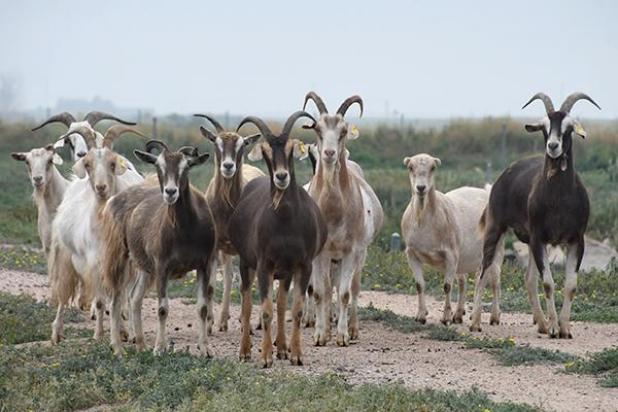
The current crew of city goats is pictured at the wastewater treatment plant, where they spend their days hoofing it around the perimeters of the lagoons to devour weeds. This allows city workers easier access to the lagoon aerators when they are in need of maintenance. Without the goats, the weeds can grow very high and make it much more difficult for them to complete their work. — The Holyoke Enterprise | Johnson Publications

This city goat has just finished eating an apple as a special treat, and its face shows just how good it was. — The Holyoke Enterprise | Johnson Publications
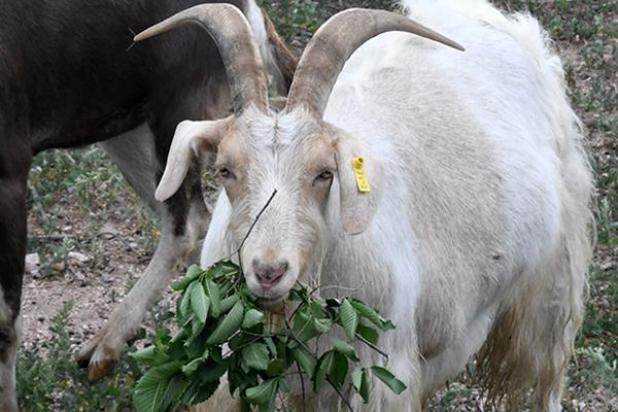
One of the 10 city goats at the wastewater treatment plant munches on a crunchy breakfast branch. — The Holyoke Enterprise | Johnson Publications
City goats baaad news for weeds
It takes a lot of hard work and coordination to run a city. In Holyoke, personnel from all departments have to work together to make sure it functions smoothly.
That sometimes means engaging some four-legged friends for help.
A herd of city-owned goats at the wastewater treatment plant on County Road 41 has bitten off their share of municipal responsibilities — and they’re chewing through any obstacles in the way.
Lennie Fisbeck, foreman of the city’s water department, said the herd’s job is to keep weeds down in the summer.
City crews check the meter at the lift station at the wastewater treatment plant every day of the year. State regulations require them to record the number of gallons that flow into the lift station daily.
Two of the four lagoons at the wastewater treatment plant have two aerators each. Concrete slabs line the lagoon banks to help mitigate erosion. City personnel are unable to mow by the slabs, so the goats have their plates full with their weed-trimming job.
Without the goats to keep the weeds down, it would be a lot harder to fix aerators in the lagoons since the weeds can grow about waist-high if left alone.
Fisbeck said when he first started with the city in 1997, he wondered why the goats were there. Since the lift station was being built around that same time, the goats had to be temporarily moved to another city lot.
He said it was a real lesson for him when he discovered that the weeds were so thick without the goats that it was difficult to get to the edge of lagoons to repair or maintain the aerators.
“It definitely makes it better with them there,” he added.
Goats have a well-known reputation for eating just about anything, but Fisbeck said some goats are better at controlling the weeds than others.
Younger goats typically have better metabolism and can simply eat more food, he said. He added that older goats are just not as willing to walk as far for food.
He said the goats don’t always eat the weeds when they’re green or at their most tender. Instead, like the connoisseurs they are, they wait until some weeds age a bit.
Currently, there are 10 goats living at the lagoons — seven neutered males and three females. They are originally from two different herds, and the current group has been there for about six years.
Fisbeck said the city tries to keep eight to 10 goats there at a given time, although that number can fluctuate.
Dogs have gotten to some of the goats in the past, but after the installation of a sturdier chain-link fence in about 2018, the goats have had better protection.
The number of goats can also increase, but this only happens with the city’s knowledge since a billy goat would have to be brought in to breed.
Fisbeck noted that the goats are pretty much self-sufficient from May-October, when they eat weeds and drink water from the lagoons.
“In the winter, they kind of just freeload off the city,” he said with a laugh.
City workers make sure the goats have plenty of water in the winter, but the lack of edible plants in cold weather means they need a different food source during those months.
The city leases out some land that’s used to raise alfalfa around the cemetery, and they get two bales from each cutting to use for goat food.
Fisbeck said the goats aren’t usually named except for the occasional nickname, noting that naming animals can lead to attachment.
But it can also be hard not to feel a certain level of attachment for this four-legged crew and the unique work it does for Holyoke.