
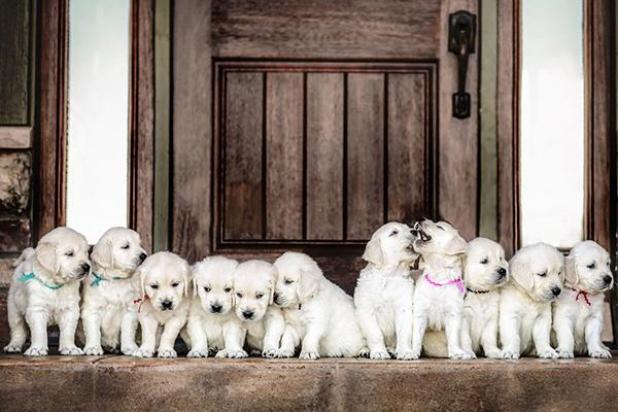
Gillian Krueger’s dog Luna’s most recent litter of puppies is pictured on Aug. 27, 2021. — Brianna Brauer
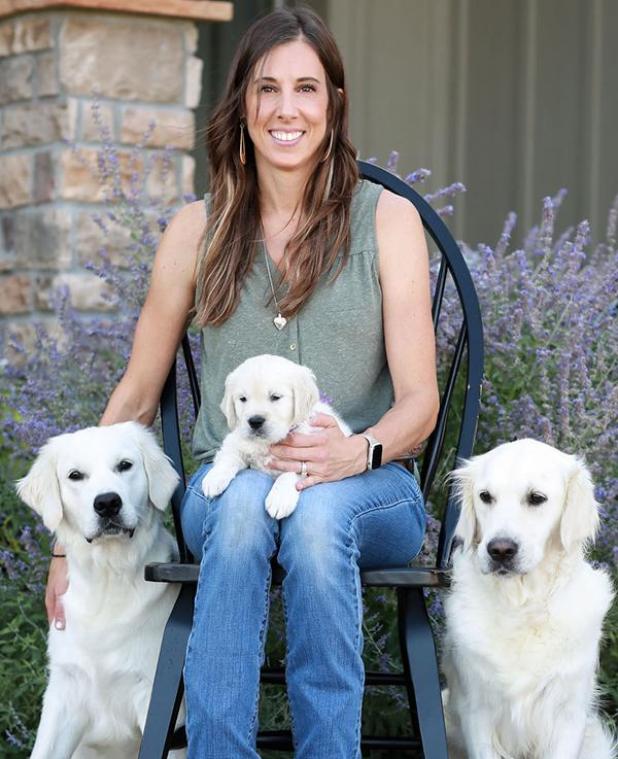
Gillian Krueger of Country Pearls Goldens is pictured holding a puppy as she sits with her dogs Castle, at left, and Luna. — Brianna Brauer
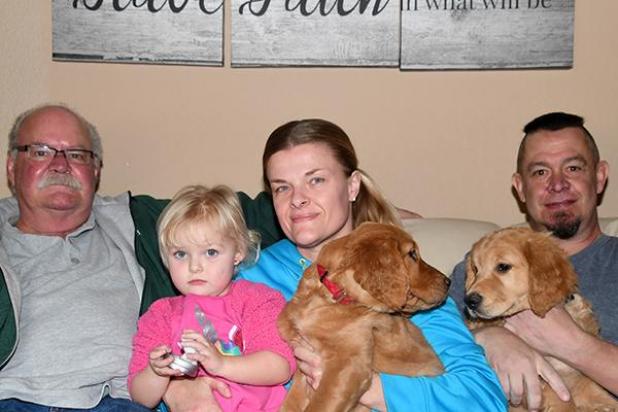
Pictured from left are Darrel Krieg, Olivia Wilcox and her mother Lacie Mese, and Kameron Krieg. Mese and Kameron are holding two of Hanna’s puppies, who were born Oct. 5, 2021. — The Holyoke Enterprise
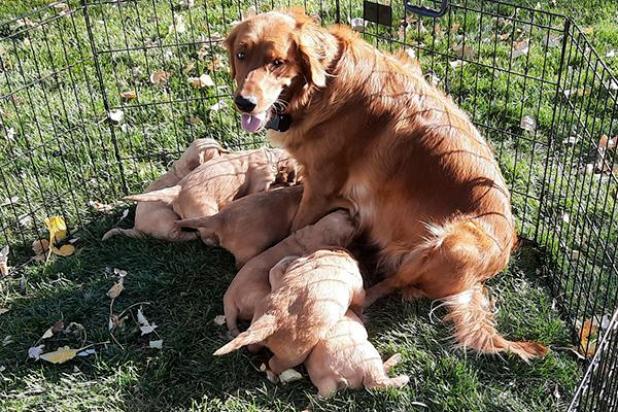
Darrel Krieg’s dog Hanna is pictured with her first litter of puppies on Oct. 26, 2021.
Friends for life
Dogs have often been called man’s best friend, and with good reason — these furry four-legged friends have been bred to perform countless tasks and jobs to help their bipedal buddies. Even beyond that, they are often viewed as members of the family, providing unconditional love and priceless, cherished memories.
To say these pets are special to many people is an understatement, and it takes a special type of person to put in the hard work and effort it takes to get these canine companions into people’s lives.
Gillian Krueger of Country Pearls Goldens has been breeding English cream golden retrievers since 2015, and Darrel Krieg and his family recently had their first experience in breeding American golden retrievers last fall.
Their perspectives can provide insight into what it’s like to facilitate the dog breeding process, which can be frightening and heartbreaking, but also fulfilling and rewarding.
Krueger carries on family tradition
Krueger is a third-generation dog breeder. Her grandparents bred cairn terriers, and her parents bred American golden retrievers.
Krueger said English cream golden retrievers are a little smaller and lighter in color than American golden retrievers. She also said that English cream golden retrievers aren’t as hyper and relax more quickly than American golden retrievers.
Krueger grew up in Longmont wanting to be a veterinarian. Her family initially didn’t have a dog, but she kept pushing her parents to get one. Her father took her to the humane society every weekend to walk the dogs there.
Eventually, her parents bought Willow, an American golden retriever, from a breeder, and Krueger had her first dog.
“They just loved the golden retriever breed,” she said, adding that Willow brought even more joy into their house than expected and never growled or snarled.
In terms of breeding English cream golden retrievers, Krueger was quick to point out that her mentor, Naddy Cato of Brush, took her under her wing and helped her more than she can ever pay back. Cato has been a huge help for Krueger in navigating the industry and pushing her to keep doing better.
Krueger said that when it comes to breeding, it has always been her mission to make the breed better and help the dogs live long and healthy lives.
To help fulfill that mission, all of Krueger’s dogs are certified by the Orthopedic Foundation for Animals, which rates the dogs’ hips, elbows, eyes and heart. They have to pass those certifications to be qualified by the American Kennel Club to breed.
Additionally, she has genetic testing done on the dogs through Animal Genetics, which can test birds, horses and more in addition to dogs. They perform a full panel on golden retrievers, who are prone to eye and heart diseases.
Krueger added that the cancer rate is roughly 60% for American golden retrievers and 40% for English cream golden retrievers.
This has led her to make sure her dogs exercise every day and have great nutrition. They have a trail on their property that they drive a four-wheeler on so the dogs can follow and chase birds, and she feeds her dogs a homemade raw diet that primarily includes meat and vegetables.
Krueger said that while she feels like she’s doing what she’s meant to be doing — breeding dogs into people’s lives — it is not all glamorous and cute.
She has stayed up with dogs that went into labor at 10 p.m. and didn’t stop until 6 or 7 a.m., and puppies have died in her arms.
She has had friends and family members who want to breed dogs, but she said there’s always a little voice in her head that hesitates in advising them to get into it since she knows the risks involved.
“I cried every time the puppies left,” she said. “I still do, but that’s part of it. The day I stop caring like that is the day that I should quit.”
Krueger said the typical waiting list for one of her puppies is at least a year long. Families usually take possession of a puppy when it is around 9 weeks old, and she said it takes six and a half to seven weeks before she figures out which puppy is going to which home.
She herself ultimately decides in what homes to place the puppies. This comes after a potential owner fills out a detailed questionnaire and has a phone conversation with Krueger, who uses these methods to get to know the families, what activities they do, what other pets are in their home and more.
She spends so much time with the puppies that she knows what their personalities are, and she pointed out that the puppies may act differently when a new person is around them.
She maintains a connection to the families who purchase the puppies and remains in touch with them afterward, always making herself available to answer questions or hear about how the dogs are.
Her female dogs are bred once a year and only until they’re 6 years old. Krueger’s female dog, Luna, turned 4 on New Year’s Day. She has had two litters, the most recent of which included 11 puppies born July 19, 2021.
Krueger said the females usually start having litters after they’re 2 years old, and they usually have larger litters when they’re younger, but this is not always the case. What’s most important is making sure they’re ready to be bred since the older they get, the harder it can be on them.
She said females cycle roughly twice per year and have a 63-day gestation period. The puppies start weaning at about 3-4 weeks old.
To make sure the mother’s health and potential puppies’ health are addressed, Krueger has her regular veterinarian examine the mother in addition to a reproductive veterinarian examination prior to breeding.
Krueger got Castle, a 1-year-old male from Hungary, in June 2021. He will be a stud, but he won’t be able to get OFA certified through AKC until he is 2. Krueger requires studs to be OFA certified through AKC as well as have genetic testing done on them.
“If you breed unhealthy puppies, you’re just breeding heartbreak for someone else,” she said.
Krueger understands the heartache that can come with breeding. She said she has been involved with five litters since 2015 — two from Luna and three from Pearl, who died in July 2021 at the age of 6.
“It helps me empathize more,” Krueger said, pointing out that she often talks to people who are looking for a new puppy because they recently lost a dog of their own.
“We know that pain,” she continued. “You can always take those bad circumstances or moments in your life and use them to help people.”
Castle’s goofiness helped ease the loss of Pearl. She said he knew exactly what to do and would nuzzle her and her family and then do something silly to make them laugh.
“He didn’t let us stay sad long,” she said. “A true golden retriever.”
Krueger said she loves when people ask her questions about her program. She said it is a big red flag if a breeder doesn’t let a prospective buyer on their property to see the puppies.
“You should always be able to see the dogs, where they’re staying and where the puppies are born,” she said.
She added that people looking for a puppy should be careful who they buy from and ask questions to find out what they’re supporting.
“You should never feel bad about asking a breeder questions, and they shouldn’t make you feel bad about asking,” she said.
Krueger is happy to answer questions and even provide questions for buyers to ask other breeders. On her website, countrypearlsgoldens.com, there is a page that includes a list of questions people can ask any breeder, and Krueger includes her own answers to those very questions on the same page.
Those interested can get in touch with her through the website, email countrypearlsgoldens@gmail.com or use the Country Pearls Goldens Facebook page.
“I thank God every day that I’m able to do what I love,” said Krueger.
First-time breeders share experience
Darrel Krieg, his son Kameron and his stepdaughter Lacie Mese recently went through the breeding process for the first time with their AKC-certified American golden retriever, Hanna, who is 2 1/2 years old.
Darrel got Hanna in Grant, Nebraska, in September 2019. When he got to Grant, there were 15 or 16 puppies left to choose from.
It was a hot day, and the puppies were peeling off from the group to find shade. But Hanna stayed close to Darrel and didn’t follow the others to the cooler area.
“Hanna actually picked me out,” said Darrel with a laugh.
Darrel has owned American golden retrievers before, and he said he had the idea of breeding Hanna in the back of his mind.
When he took her to the veterinarian, he was told that Hanna has good features and hips for breeding and that he should look into it after she was 2 years old.
This past July, Darrel took Hanna to Lafayette, where she was bred with an AKC-registered stud. Hanna had an ultrasound about 35 days later that confirmed she was pregnant.
On Oct. 5, 2021, Hanna gave birth to seven puppies — five males and two females.
Darrel remembered telling Kameron in the days leading up to the birth that Hanna was getting close to having her litter since she had started digging at the floor under Darrel’s bed in apparent preparation.
Darrel was helping CHS Grainland get ready for corn harvest at the time, but Kameron and Mese were present to see the puppies’ birth under Darrel’s bed.
“It was incredible,” Mese said, pointing out that it was her first time delivering puppies. “It was quite an experience.”
Kameron said they watched and let Hanna do it, and the process went smoothly as they towelled off the newborn puppies. All of them were born healthy, and the whole labor process took about an hour and a half.
The puppies stayed in Darrel’s room for about two or three days before they were moved to a whelping box in the garage. Kameron built a roof for the box and put a heater inside, and the three of them made sure to wash the blankets and sheets that were in the whelping box every day.
Mese noted with a laugh that the daily washing was not one of the most fun parts of the process.
Hanna stayed with the puppies day and night until they were about 4 1/2 weeks old, when Hanna appeared to begin instinctively weaning them, not allowing them to suckle.
“We’ve learned a lot,” Darrel said, adding that he plans to breed Hanna again, likely in January 2023 so she can have puppies in the spring when the weather’s warmer. “I enjoyed all of it,” he said. “It’s a lot of work, but it’s fun.”
The puppies were available about the first week of December. Darrel plans to keep one, Calvin, and the remaining puppy was sold last week.
The family has gotten to spend a lot of time with the puppies, and Darrel and Kameron recently took Calvin and his brother out hunting.
Kameron said Hanna gets frightened at the sight of a shotgun or a rifle. The puppies, on the other hand, weren’t scared at all and seemed to take right to it.
Although Hanna usually doesn’t get out of the vehicle when they go hunting, they said she is getting braver, and she might even start to like hunting more now that she’ll be able to do it with her puppy, Calvin, by her side.