
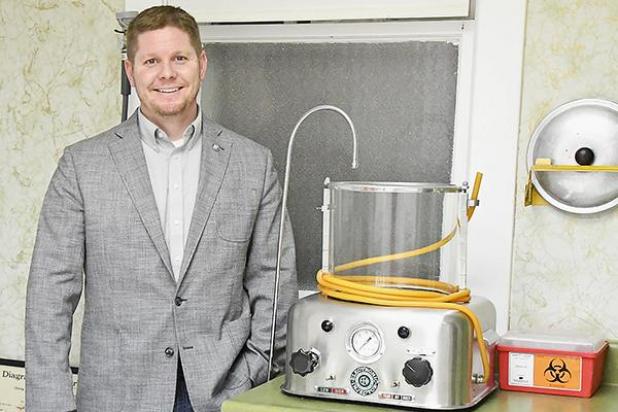
Michal Swanson of Liewer Funeral Home shows the embalming machine used at the funeral home in Imperial. — Johnson Publications
Funeral Myth Busters
Liewer Funeral Home in Imperial hosted a “Funeral Myth Busters” class in conjunction with Mid-Plains Community College in early February.
Michal Swanson, a mortician at the funeral home, led the evening’s discussion, highlighting everything from how the embalming process works to pre-planning for your loved ones.
The funeral business
“Things were pretty much done the same way as 100 years ago” as far as embalming, visitations and funerals go, Swanson said.
“Over the last 50-60 years, personalization and the ability to change things (for your funeral) has become very popular,” he added.
Traditionally the funeral directors/undertakers/morticians typically wore two hats back in the Old West, like when Imperial was founded, Swanson said.
“They were usually carpenters, because they started making caskets when people needed it, and then they became a funeral director as well,” he said.
Embalming process
Every state has different rules and regulations for embalming. In Nebraska, if you want a public viewing — meaning a visitation for those outside immediate family — a person has to be embalmed.
“If you want to be cremated but you have some family members that need time to get back, we have the 24-hour window,” Swanson said.
The 24-hour window gives the family 24 hours from the time of death to make a decision: embalming or cremation.
However, if a little longer is needed for families, Liewer Funeral Home can use refrigeration facilities in McCook, giving families up to 72 hours.
The embalming process is simply switching the blood in an individual’s body with embalming fluid.
“It’s kind of like how your car system is closed,”Swanson said. “So the blood comes out and you’re making a swap for the embalming fluid,” he added.
The main reason for embalming is to disinfect.
“It also helps firm tissues and gives the body a pink color for viewings,” Swanson said.
“People always ask me, ‘Where’s the blood go?’ It goes straight into the sewer system. And that’s every funeral home in Nebraska.”
One question Swanson received was whether the mouth of an individual is sewn shut during the embalming process.
“No,” he answered. “The embalming fluid has a fixation factor that helps, but sometimes a needle injector can be used to make sure the mouth itself stays shut.”
Swanson said they also use a product called Aron Alpha Sealer.
“I’m pretty sure it’s just super glue,” he said. “And that is used to make sure eyelids and lips stay closed.”
Whether an individual chooses to be cremated or have traditional services, the embalming process is the same.
“If you want to be cremated and have no visitation, you don’t need to be embalmed at all,” Swanson said.
One example he gave was for most Catholic churches.
“They’ll still want to have viewing, rosary and visitation, but then Grandpa wants to be cremated,” he said.
“So we would embalm him then we have what we call a rental casket,” Swanson added. “It sounds kind of funny but it’s a solid oak casket and on the inside, everything comes out of it, so we can have the viewing and the funeral and everything like that.”
Instead of going to the cemetery, the individual would be taken to the crematory.
Cremation
Liewer Funeral Home uses the crematory in McCook.
To be cremated, the temperatures range from between about 1,400 and 1,700 degrees.
It takes a couple hours to reach those temperatures, Swanson added.
“After the body cools, it’s not the fine ashes you’re used to seeing,” he said.
Read the full article and the entire Have the Time of Your Life special section online for FREE.