
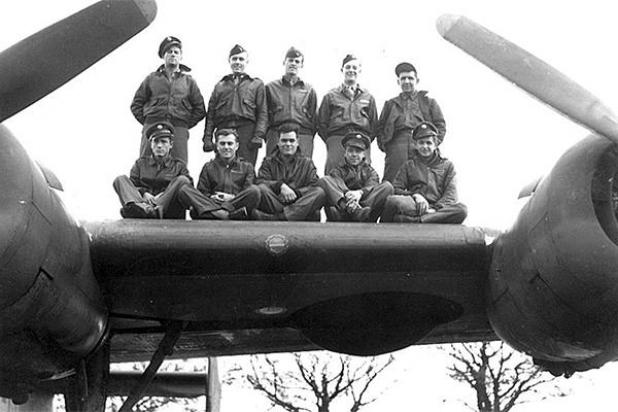
Lewis Getchell is pictured sitting in the center on the wing of a B-24 bomber with the crew of the 705th Squadron of the 446th Bomb Group of the 8th Air Force stationed in Bungay, England, during World War II.
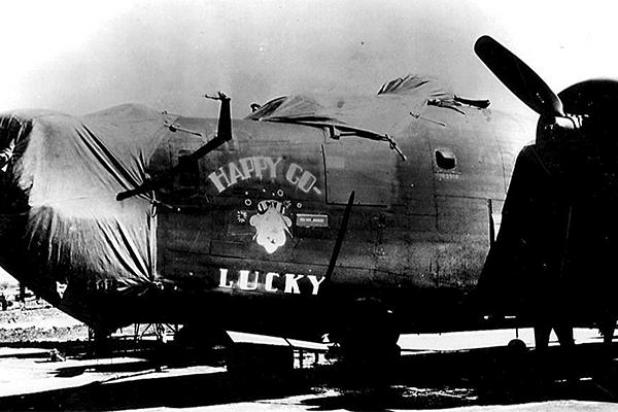
Pictured is “Happy Go Lucky,” the B-24 bomber used by Lewis Getchell’s crew during World War II.
Happy Go Lucky
On March 6, 1944, at 3 a.m., something awakened Lewis Getchell’s family. “Where was he at that time?” they wondered. They began to pray for God to protect him, said Leroy Getchell, Lewis’ son.
Lewis was inducted into the Army Air Corps on his 22nd birthday, Oct. 8, 1942, and trained as a waist gunner on a B-24 bomber at Lowry Air Force Base in Denver. On Oct. 18, 1943, the 705th Squadron of the 446th Bomb Group of the 8th Air Force departed for Bungay, England.
Each squadron was assigned 25 missions in their tour of duty. On many, many occasions, crews faced fatal problems or the aircraft was shot down on their very last mission, Lewis had told Leroy. Perhaps God’s hand was on this plane as they completed all of their assigned missions and lived to tell about it.
Tail gunner Sgt. George R. “Pee Wee” McCloud kept a diary detailing the missions that the crew of B-24 bomber “Happy Go Lucky” completed during WWII. Lewis was assigned to this squadron. What follows are excerpts from the diary with comments from his son, Leroy.
No. 1, port at Bremen, Germany
Dec. 16, 1943
Because there were hundreds of bombers going out on each mission, it took two hours for all the planes to get off the ground and group up into formation, Leroy noted. He also mentioned that his father told him that when they where over enemy fire, the flak would be so thick you could walk on it.
McCloud — “After taking off, we circled the field for about two hours while our squadron formed into its formation and then joined the bomber group in our position in the wing. When we were over Bremen, all hell broke loose. The bursts of flak were so numerous we couldn’t count them. We were told it was the worst-ever amount of flak put up against any group of bombers.
“Thanks to great evasive action by the pilot, none of it came close enough to do us any harm. We were in what we call Purple Heart territory, coming out of the target, when two of our four supercharge engines went out and we were losing speed and altitude.
“We were falling behind the group when four enemy fighters came up on us. Our friends, the P-47 fighter pilots, came to our rescue; otherwise I would not be here today to write this account of my first mission. That is the closest I have come to being killed, and that was close enough for me.”
No. 3, La Rochelle, France
Dec. 31, 1943
McCloud — “This mission was perhaps the most nerve-wracking. We flew for over four hours before we reached the target, then circled for a half hour. After we let go our bombs and left the coast of France, it looked like we wouldn’t get halfway home because we didn’t have enough gas.
“We were afraid we may have to bail out and me without a parachute. Someone had taken it out of my bag and, like a fool, I had not checked it. The good Lord kept us up and it seemed like the angels were pouring gas into the tanks.
“We finally landed, and I got out and kissed good old Mother Earth. I prayed more during that trip than I have ever prayed in my life. The good Lord took care of us.
“Thereafter I kept my hands on my chute and I never forgot it again. You can just imagine the nervous tension I went through. That was one mission I’ll never forget, so help me.”
No. 4, Kiel, Germany
Jan. 6, 1944
Leroy remembers his father talking about how cold it was during the bombing flights that winter. In particular, he mentioned the mission to Kiel, Germany, when the air temperature was 60 degrees below zero at 22,000 feet. They wore heavy leather gloves and had strict orders never to take them off. They were heavily clothed, wearing hoods, helmets, oxygen masks and goggles.
McCloud — “This was the roughest and I hope it is the only roughest of my whole tour of 25 missions.
“I saw four bombers go down and blow up in midair during this bombing run. The flak was very heavy and it was concentrated and much more accurate than ever before. Seeing planes blow into nothing right in front of your eyes does things to your stomach. I wouldn’t say it frightens a guy, but it sure makes you think things that aren’t good to think about.”
No. 5, Brunswick, Germany
Jan. 11, 1944
McCloud — “This mission without a doubt was the only mission that I have been really scared. Everybody that went that day had an intuition that this trip to Germany was going to be a bloody one. No matter who it is, we are all scared and everyone knows that whoever says he isn’t is a liar.
“Fortunately, we were called back that day, but later we found out that it turned out to be the worst air battle in the history of the war. The Germans put up over 300 planes of which the allies shot down 152. We lost 60 bombers and only 11 of the 32 B-17s came back that day. It proved that all of us had a correct feeling about the mission.”
No. 9, airfield in Holland used by the Nazis
Feb. 10, 1944
Leroy recalls his father describing having to fly in horrific fog with very little visibility, seeing only feet in front them, and how a person could feel the wake of a plane that was just barely missed.
McCloud — “This mission was the toughest except for Bremen. The opposition came in the form of weather. We hit dense clouds with snow. When we did break through at the top, it was a very beautiful sight to see all the mountains and valleys of clouds. They were beautiful, but at the same time very dangerous to fly in. It was the second coldest weather we had encountered at minus 50 degrees, and that is too cold for anybody.
“For a bunch of bombers flying in very close formation and not being able to see each other is very dangerous. We almost crashed up in midair on three different occasions. On these occasions if we had been 2 or 3 feet closer, we would have hit each other. Then we would either be 6 feet under or being interrogated as prisoners of war at a German prison camp.
“On this trip, I became the first casualty on our crew with small frostbite on my face. There were quite a few cases of it that day. Mine was bad enough to keep me grounded for a week or more and I didn’t want to fall behind on my missions with my crew.”
No. 10, Abbeville, France
Feb. 13, 1944
McCloud — “This was one of the toughest missions yet as far as flak was concerned. I convinced the flight surgeon to release me for the mission by telling him we would be flying below 12,000 feet even though I knew it wasn’t true.
“We encountered the most accurate flak we have ever come up against in the first nine missions. Those guys in France now are far from amateurs; in fact they are probably the top professionals of Germany. By some freak of fate or by God’s guiding hand, we only found one hole in the bomb bay door after the mission.”
No. 12, Gotha, Germany
Feb. 24, 1944
McCloud — “We have been going deeper and deeper into Germany day after day. We had been under attack by enemy fighters for about two hours by the time we released the bombs on Gotha. We hit the targets well, but we were under attack by enemy fighters all the way out again besides getting heavy barrages of flak.
“I was very glad to get down on terra firma that night after flying almost eight hours continually under fire. It is far from being fun. Our crew has 12 missions in now and we have the big No. 13 coming up, taking us over the hump.”
No. 16, The first mass daylight bombing of Berlin, Germany
March 6, 1944
Leroy explained that by this time, the military had P-51 fighter planes, which were bigger and could carry extra fuel to go with the bombers into Berlin. On this mission, his father told him, the German fighter planes were following them for 20-30 minutes. “Happy Go Lucky” hobbled back to England on three engines and no fuel, he added.
The pilot had to circle the landing field a few times to get the proper approach because of the engine failure. After the crew landed, they were told that they didn’t have enough fuel to have circled one more time, Leroy noted.
This was the day Lewis’ family was unexpectedly awakened and prayed for his safety. Leroy said, “As Paul Harvey would say, ‘And now the rest of the story.’”
McCloud — “This mission came as the closest I have ever come to making my last mission in the war and also my very last breath of life. Thanks to God for being our pilot that day, I am able to be here now to write this up.
“The intended target was Berlin’s Grand Central railroad station. When we got over Berlin, all hell broke loose, and I mean broke loose. We were under the worst taste of war I ever got. Every gun Germany ever owned must have been in Berlin on that bloody Monday, as the Germans refer to it. Every shot I thought was knocking our plane apart. We got several bad holes that just missed blowing us up. Just as our bombs were released, a big piece of shrapnel struck our No. 1 cylinder, causing the engine to catch fire.
“The pilot, co-pilot and engineer tried four times to feather the engine to put out the fire. On a last desperate attempt, they got it feathered. The plane was flying sideways as a result of the feathered engine. With enemy fighters all around, we thought we were finished because whenever a plane is that far into Germany with a feathered engine, they don’t get back home.
“An enemy fighter came up behind and I had my guns trained on him and was just ready to fire when two P-47s came down at him. The enemy broke away and tried to run but the 47s got him.
“From there on out, there were from 10-12 P-47s protecting us all the way out. From there home, our greatest worry was whether the other three engines would stand the strain of doing the job of four engines.
“We didn’t think we had enough gas to make the channel, and the navigator gave directions that took us on the longest distance over the channel but the shortest distance to the base.
“We were congratulated for making it back, and even our pilot doesn’t know how we ever managed to get back. The only explanation is that God was flying our plane back from Berlin that day.”
After their 17th mission, the crew received notice that the tour of duty had been increased to 30 missions instead of the initial 25. Because the crew of “Happy Go Lucky” had completed over 15 missions, they received two two-for-one missions, leaving their total at 28.
After completing all 28 missions, the men returned home to Lowry Air Force Base and were training on a B-28, preparing for duty in the Asian-Pacific Theater, when the war ended.
Leroy noted that “Happy Go Lucky” was turned over to another crew after the 705th Squadron returned to the states. Shortly after, it was shot down over the North Sea and all 10 crew members were killed. Somehow God had his hand on that plane while his father flew on it, he said.
In the European Theater of Operations, American targets were industrial by nature, Leroy said. It was a strict rule that no bombs be dropped in German-occupied Europe unless there was a designated target.
The Americans flew during the day while British airmen flew at night with indiscriminate targets, he added. Their hits were intended to demoralize Germany.
Lewis was a 1939 graduate of Phillips County High School and returned to Holyoke after the war. He started a gravel hauling business, which he sold in 1960 when he and his family moved from Holyoke. Lewis died in Joplin, Missouri, Dec. 7, 2017, and was buried at the Holyoke Cemetery Dec. 14.