
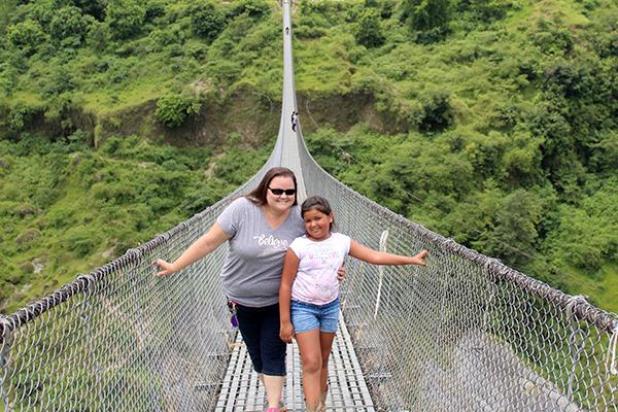
While traveling to a village in Nepal, Kelly Farrell and daughter Elizabeth make a pit stop at a bridge in the Annapurna Conservation Area in the Himalayas.
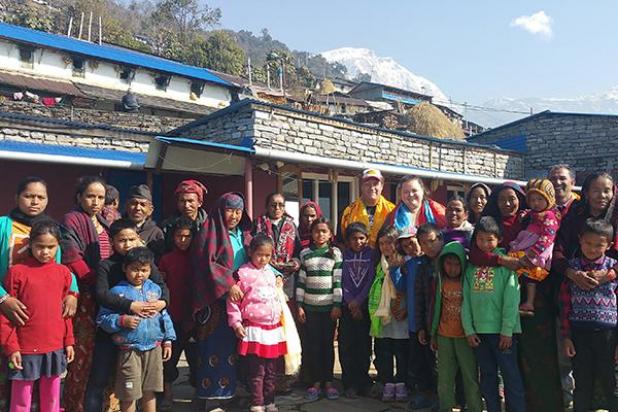
Matt and Kelly Farrell, pictured to the right of center, stand behind daughter Elizabeth with a group of locals in the village of Sikles, Nepal. The Farrells regularly travel there from their home in Pohkara, Nepal, to do an outreach program with children and their families.
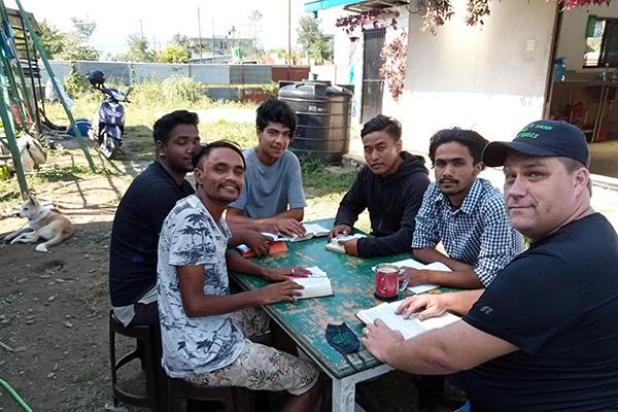
Matt Farrell, at right, hosts a study group with young men at his farm in Pokhara, Nepal.
A higher calling
Water is pumped into tanks at the home, and a solar device helps heat the water. There’s electricity, but it must be used wisely — don’t even think of running several devices or appliances at one time. And don’t forget to have backup batteries available for when the power goes out — which is quite often.
There’s no central heating, but don’t worry, the average high temperature in January is 67.5 F. However, get ready for some rain in the summer — the average annual precipitation is 153.6 inches.
Certain fresh foods can be hard to find in the off-season, and a walk to a small grocery store is all that’s available during extreme pandemic lockdowns. But watch out for the water buffalo, which are known to roam the streets.
Views of the massive Himalayas might make being thousands of miles away from family a little easier, but it’s the work with local children and young adults that makes it all worth it.
For the last six years, Pokhara, Nepal, has been home for the Farrell family — Matt and Kelly with daughter Elizabeth, age 10, and Jeremiah, age 9 months.
“It’s a simple life. You just fall in love with it,” said Kelly.
The Farrells took a small break from Nepal last fall, taking advantage of one of the country’s first regular international flights after strict COVID-19 shutdowns. They enjoyed time with Matt’s family in North Carolina at Thanksgiving, followed by over a month in Holyoke for some rest and the holidays with Kelly’s parents, Jerry and Sue Cooper.
Holyoke is no doubt an entirely different world than Pokhara. With a population of 523,000, Pokhara is the second largest city in Nepal, a landlocked country in South Asia sandwiched between India and Tibet. Sitting in the center of the country, Pokhara is situated in a valley with a humid subtropical climate. The city’s lowest elevation is 2,713 feet, rising to 5,710 feet at its highest point. It’s called the tourism capital of Nepal because many people use it as a gateway to the Annapurna Circuit trails in the Himalayas.
As a young adult, Kelly participated in many short-term humanitarian trips all over the world, but after a trip to Nepal in high school, she knew she wanted to go back and serve the Nepali people.
Matt also has extensive experience in humanitarian work, including 12 years of leading groups internationally through an organization called Youth with a Mission.
Ironically, Matt and Kelly both grew up in Loveland, but they didn’t meet until they were halfway around the world in Nepal.
A mutual friend from Colorado notified Kelly, who was already in Nepal, when Matt was headed to Nepal, and Kelly invited him to be a friend on Facebook. A month later, they went out for pizza, and the rest is history!
The Farrells have a nonprofit called House of Treasures. It’s based on the theme that “where your treasure is, there your heart will be also.”
The nonprofit’s mission is to share love with the children of Nepal through care, education, nutrition and love while also meeting their practical needs.
House of Treasures partners with an orphanage that has about 40 children who have lost one or both of their parents or who came from abusive situations. Their ages range from 3-17 years.
The goal of the orphanage is to create an environment that nurtures the children and allows them to feel accepted into a family. And once they join this big, noisy, chaotic and loving family, they are part of the family forever.
In fact, a boy who was raised at the orphanage expressed a desire to open a children’s home of his own. House of Treasures has now come alongside him and the three boys who live there.
Kelly goes to the orphanage regularly to put on a children’s program, and the older girls attend a study at the Farrells’ home while Matt works with the older boys on their farm.
Farrell’s Farm and Aquaponics is a business that Matt oversees. Right now, six boys who have transitioned out of the orphanage live at the farm to gain essential work and life skills they’ll need as adults. In Nepal, children at the orphanage aren’t allowed to do chores, so during their time at the farm, the boys learn how to cook, clean and more.
The farm mostly grows salad greens, something that other farms in the area don’t have. The Farrells found there’s actually a demand for it because of the thriving tourism industry in Pokhara.
The Farrells also support a school with about 400 children in one of the poorest areas of the city. They have helped make it possible for about 300 of the students to attend the school on a scholarship.
For a time, the Farrells ran a feeding center on Saturdays for about 75 boys who lived on the street in Pokhara. The good news is that after a while the center was no longer needed because most of the boys are now off the street. “It’s cool to see them participating in society,” said Matt, noting that they have run into participants on occasion and are so happy to see them doing so well.
A few times a year, the family gets out of Pokhara to visit a small village, which is something Kelly also got to experience on her short-term trip. While it might be a picturesque landscape, the four-hour, four-wheel-drive trip on a bumpy road that takes them high into the mountains is an adventure all in itself.
The Farrells began breaking down barriers by sponsoring school supplies for 10 children and then inviting them and their families to a summer outreach.
Much has changed after all their trips to the village. Now they are greeted with not only open arms but also beautiful flower necklaces. And while they’re there, they get to spend time encouraging a small house church that has popped up.
In Pokhara, the Farrells have a church they attend, and they especially enjoy it when multiple denominations in the city come together for joint services.
They make an effort to get to know people on a personal level before sharing certain parts of their values and beliefs with them. “You have to be creative,” said Matt, pointing out the increasing persecution in the country.
Matt and Kelly have spent countless hours studying the Nepali language, which uses the same script as Hindi. Even though a lot of people speak English, the use of Nepali is critical in some circumstances. And in the smaller villages, some people speak other native language, making translating tasks almost comical for this American family.
They have had to get used to people staring at them all the time as well as many cultural differences, like the utter lack of a time schedule for events and not being able to use their left hand in public because it’s considered unclean. Good advice for any situation is to “always be observant of how they do it first,” said Matt.
Elizabeth is homeschooled and has local friends that she enjoys playing with. At 10 years old she has spent most of her life in Nepal and has experienced things that most kids will never get to — trekking in the gorgeous mountains, swimming in rivers with crystal clear waters, walking on suspended bridges, riding an elephant through a forest and boating in a canoe through alligator waters.
And someday, the family’s dream is to take a helicopter ride to the base camp at Mount Everest — the world’s tallest mountain that sits on the border of Nepal.
However, all of those things plus outreach opportunities were put on hold when the COVID-19 pandemic turned the world upside down.
From about April to September in 2020, Pokhara was in extreme lockdown. Police patrolled the streets, and residents were only allowed to walk from their homes to the store — open for two hours a day — to buy groceries.
All trips to the orphanage and school had to be canceled, and Matt only went to the farm a couple of times. As an employer, he was allowed to go there to pay the young men who were working at the farm.
On top of it all, baby Jeremiah decided to make his arrival on April 14. Just getting to the hospital for the delivery was harder than normal. The Farrells’ car wouldn’t start, and after several of their friends didn’t answer their phones, a cab driver they knew made a risky move by agreeing to drive them even though travel by car was not allowed.
Jeremiah had to be in the neonatal intensive care unit for two weeks and was actually sent to the capital city of Kathmandu — a transfer that required a special letter of permission just to go from one district of the country to another. While in the hospital, the Farrells had to get creative since nothing was open to buy food from and the hospital fare left much to be desired.
Once they were back home, they made do with only three outfits for Jeremiah for the first six months. No stores were open to buy clothes, the planned baby showers had been canceled, and Grandma Sue’s flight to Nepal with gifts never happened.
Before heading back to the States, the Farrells had to wait patiently to get all of Jeremiah’s paperwork in order since the embassy was closed.
But one good thing about the pandemic is that the Farrells were able to get to know and make friends with the police at the checkpoints on the rare occasions when they were able to leave the house.
To learn more about the Farrells’ work in Nepal, visit www.houseoftreasuresnepal.org and www.facebook.com/farrellsfarmandaquaponics.
Those wanting to send a donation can mail it to House of Treasures, P.O. Box 264, Holyoke, CO 80734.