
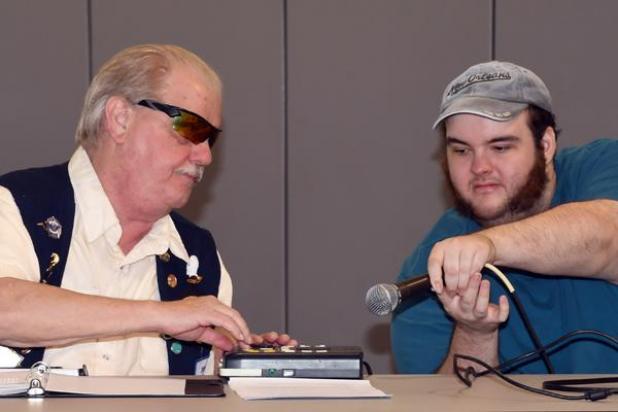
Mark Meusborn, at left, demonstrates how his digital book player works as Zach Young holds a microphone close by so guests at Saturday’s Meet the Blind event can hear. — The Holyoke Enterprise | Johnson Publications
Meet the Blind event offers education on managing blindness, technology that assists
Community members who attended the Meet the Blind event Saturday, Oct. 16, at the Peerless Theatre were treated to a presentation by Mark Meusborn that provided details about how he manages blindness and what technology is available to help.
October is Blind Equality Achievement Month, and Oct. 15 was White Cane Safety Day, so Saturday’s event was a great time for Meusborn to share his experiences as a blind person, demonstrate how he uses his cane and more.
The event was sponsored by the Holyoke Lions Club. Sharon Bishop was originally scheduled to be a second guest speaker but was unable to attend.
Meusborn was born blind but with some vision in one eye that allowed him to read large print when he was a child. After moving to Fountain, he graduated from the Colorado School for the Deaf and Blind in Colorado Springs in 1972.
Meusborn said he liked working with power tools and wanted to be a cabinet maker after graduation. He went to Denver as part of an independent living program, learning how to use his cane and travel independently.
He said he learned many life skills at the independent living program and started food service training.
“You have to learn how to be blind,” Meusborn said, emphasizing that blind people have to learn how to rely on touch and listen to identify sounds like traffic to figure out what the vehicles are doing when he’s outside.
Meusborn pointed out that it’s sometimes harder for him to travel in Holyoke than in Colorado Springs or Denver since there’s less traffic volume for him to listen for in small towns.
In 2007, he relocated to Arkansas to work in bicycle repair. His teacher told him bicycle repair would likely be too easy for him, so Meusborn worked in small engine repair instead and moved back to Holyoke in 2009.
Canes, dog guides help with mobility
Meusborn said sometimes there is a debate within the blind community about the benefits of using a white cane or a dog guide for help getting around.
Meusborn demonstrated the use of his cane, which is collapsible. He can gather lots of information by tapping the cane’s metal tip on the floor when he enters the room. By listening to the noise and the echo, he can get information about what the floor is made of, the room’s size and how many people are in the room.
He said using a dog can help a person get from point A to point B, but the dogs need to be trained to do so. He said his own preference is to use his cane, which allows him more opportunities to explore.
In fact, Meusborn said he used to get purposely lost with a friend in Denver in what they called “Tom Sawyer adventures” or just a “Tommy.” He added that getting lost and asking questions allowed him to learn more about where things were located and how he could get from place to place.
Meusborn discusses National Federation of the Blind
Meusborn shed light on the work that the National Federation of the Blind has done to promote independence for blind people.
When Meusborn joined the organization in 1983, the NFB was working on airline policies for the blind.
At the time, blind people had to preboard airplanes and sit in the bulkhead seat of the plane, where there’s not much leg room. Additionally, blind people could not sit at the emergency exits of the planes. Meusborn said the NFB fought throughout the 1980s to change all of that.
Meusborn noted that the NFB also helped start the Talking Book program and made sure the use of 411 directory assistance was free for blind people at a time when there was a charge to use the service.
Technology that assists the blind highlighted
The unemployment rate for blind people is 70%, said Meusborn. He added that while it’s getting better with technology, some people just don’t give blind people the opportunity.
To help try to solve this problem, the NFB hosts job opportunities for the blind conferences at its conventions each year. There are also exhibits and displays of anything related to helping blind people, including technology like talking clocks, talking scales and more.
Meusborn demonstrated a digital book player that plays cartridges. Each cartridge has 10 books on it, and Meusborn gets a catalog with a list of available books every two months.
He also discussed the braille writing system, which he learned in fifth grade. He demonstrated a braille writer and a braille slate, which clamps the paper and allows a person to use a stylus to make the necessary marks.
Using his cellphone, he showed attendees how the KNFB Reader app allows him to take a picture of a printed document and have it read to him.
He also demonstrated the Aira service he subscribes to, which is an app that connects blind people to trained, remotely located agents who provide the caller with access to visual information.
In the demonstration, the agent Meusborn contacted described what he saw in the room where the event was held as Meusborn panned his phone around the room. The agent provided Meusborn with an estimate about how large the room is, told him where the guests were sitting and more.
Meusborn also discussed descriptive video technology, which describes what’s happening on the screen during movies and TV shows. He said the descriptions are read in between the moments of movie dialogue so the person can also hear the characters’ conversations.
The demonstrations and presentation given by Meusborn to the attendees helped raise awareness and educate the community about the blind and the ways technology can assist them in managing their lives independently.