
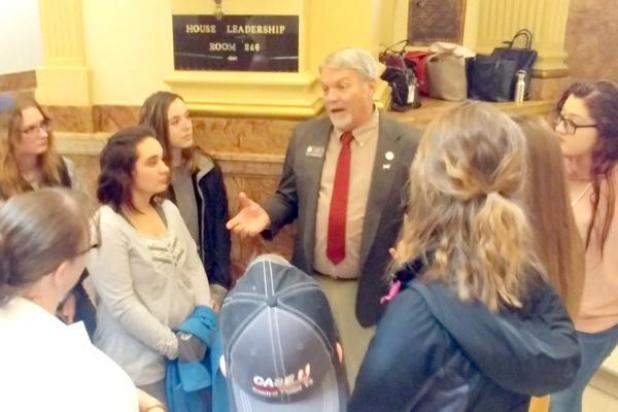
Rod Pelton, center, is wrapping up four sessions as the representative for House District 65. — Courtesy Photo
Pelton reflects on last 4 years
State Rep. Rod Pelton, R-Cheyenne Wells, will continue to represent the Eastern Plains come 2023, but it will be a district (and a seat) very different from the one he currently covers.
Pelton has been the representative for House District 65 for the past four sessions, beginning in 2019. In an odd turn of fate, his county of Cheyenne is the furthest south in the district that extends all the way to the state’s northern border with Nebraska.
The representative for the southern half of the Eastern Plains, Rep. Richard Holtorf, R-Akron, lives in Washington County, the furthest north of House District 64.
Redistricting has changed the map so that the Eastern Plains are more or less cut in thirds, with Washington and Yuma counties now the southernmost of the new House District 63.
Pelton will live in the newly drawn House District 56, which already has an incumbent, Rep. Rod Bockenfeld, R-Watkins. That won’t present a challenge to Pelton, however, as he is running for the state Senate, to represent Senate District 35, which has no incumbent due to redistricting and which covers all of the Eastern Plains south of Washington and Yuma counties.
Pelton is the only Republican who will appear on the primary ballots that come out this week and is expected to win the contest handily, given that the district is likely to favor the Republican by about 45%, according to the redistricting commission.
Pelton recently reflected on his four years of representing the northern Eastern Plains.
He’s been a surprising champion for behavioral health, particularly improving behavioral health services for rural Colorado. Eight of the 10 House bills he’s sponsored in his four years in the House on those services have been signed into law, an unusual feat given that he’s been in the minority party the entire time.
Pelton admitted mental health was not the area he intended to focus on when he began his legislative career, but that’s where he’s been most effective, dealing with mental health, substance abuse, solutions for those who are intellectually and/or developmentally disabled, and rural suicide, both for youth and adult.
“We have to shine a light out here to the urban legislators who just didn’t really even have an idea of the problems we have out here,” he said recently.
He’s had successes in other issues important to rural Colorado, such as a law he sponsored last year with Sen. Jerry Sonnenberg, R-Sterling, on meat sales, that allowed sales from the producer directly to the consumer.
That was enhanced with a measure the two sponsored in the 2022 session to expand that program, by adding a staffer to the Colorado Department of Agriculture who would help ranchers and farmers with the paperwork to obtain loans or grants from the U.S. Department of Agriculture. That will help small, rural packing plants, Pelton said.
He’s also been protective of rural water, a tough issue in times of drought.
Pelton hasn’t been a show horse in the House, preferring to speak his peace, usually briefly, and that allows him to get points across that might not normally generate interest. That’s accorded him respect from urban legislators who will listen when he addresses the House during debates. “When you talk, talk, talk, nobody’s listening,” he said.
He’s most proud of bringing a strong voice to the legislature from rural Colorado, which Pelton called rewarding. There isn’t a lot of difference between urban and rural Colorado, he said, just different ways of dealing with the difficulties. “People like to know that their voice is being heard” and that someone is advocating for them.
What Pelton has found frustrating most recently is in how the state budget is crafted, by the six members of the Joint Budget Committee. “I really got to see just how much power the JBC does have, and in my opinion, a little too much.”
Republicans tried numerous amendments when the budget was in the House and lost most of those fights, although Pelton was among the few to win support for one of his amendments, to add $100,000 to the AgNext program at Colorado State University. That program focuses on research on animal agriculture that applies to the supply chain.
The process, however, isn’t what the Founding Fathers intended, Pelton said. “They wanted equal representation,” but at the Legislature, one party’s agenda is being pushed through Joint Budget Committee without any give and take. That lack of willingness to negotiate was a bit unnerving, he said.
Pelton has spent the last two legislative sessions as the minority whip, someone who ensures his caucus is ready for action.
Among the crucial debates in which he was put to the test was during the collective bargaining bill, which was watered down to exempt counties of up to 7,500, mostly on the Eastern Plains.
At one point he and Bockenfeld were invited to sit down with Majority Leader Rep. Daneya Esgar, D-Pueblo, the bill’s sponsor, to talk about the bill. Pelton attributed that invitation to his past experience, and Bockenfeld’s too, as county commissioners. The bill wound up not being “quite so ugly,” he said.
He’s also had to navigate that role within a deeply divided minority caucus. It was hard to get the whole group together unless it was on a major issue, such as collective bargaining or the bill to enshrine the right to abortion in state law.
What’s next? Pelton will likely be one of only two farmers/ranchers in the Senate in the next year, along with Sen. Cleave Simpson, R-Alamosa.
“I just try to educate my fellow caucus members on agriculture and rural Colorado,” as well as try to teach his urban counterparts about the differences, “making a living and our lifestyles. It’ll be just a smaller crowd.”