
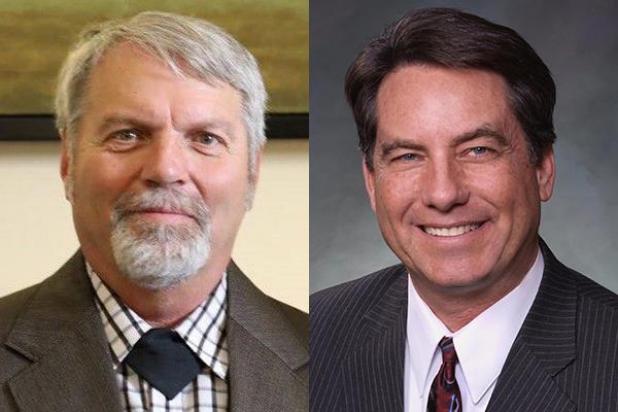
Rod Pelton, Jerry Sonnenberg
Ports of entry, teacher incentives on tap at the Capitol
Chalk up a victory, at least for now, for truckers in northeastern Colorado who would like to avoid the laborious process of going through the Fort Morgan port of entry every time they make a trip within a five-mile radius of that station.
Sen. Jerry Sonnenberg of Sterling plans this week to kill the bill that would have allowed truckers carrying agricultural commodities to bypass the port of entry.
So why is that a win?
Sonnenberg said the legislation is no longer necessary because the Colorado State Patrol, which operates the state’s 10 ports of entry, has set up a revocable permit to address the concerns raised by truckers who claim driving to the ports of entry adds mileage, time and cost to their trips.
Sonnenberg has seen the application the state patrol developed, which can be done on mobile devices. “It’s simple and online,” and best of all, free, Sonnenberg said. “They came more than 90 percent and did an incredible job of listening and trying to meet the needs, and I’m willing to give them a year before I try to run another bill.”
The permit, which can last for up to three years, shows the route the trucker wants to take that’s within the five-mile circle of the port of entry. A trucker could say, for example, that they’re hauling cattle to Greeley and how they intend to get there. Approval of the route is general, not specific, Sonnenberg said.
The state patrol’s website says that “Special Revocable Permits are available to eligible companies operating a regularly scheduled route within five road miles of a port. Applications must be submitted to the Colorado State Patrol, Port of Entry section. If a permit is issued, it relieves the permit holder of the requirement to clear the specified Port of Entry, subject to the conditions of the permit.” The permit information can be found at colorado.gov/pacific/csp/permits-and-forms.
The state patrol has 10 ports of entry locations around the state, with seven along the state’s eastern side (Fort Collins, Fort Morgan, Lamar, Limon, Monument, Platteville and Trinidad).
Pelton rethinks position on Republican River bill
A bill to expand the Republican River district cleared the House Rural Affairs and Agriculture Committee in the past week, but without the support of Rep. Rod Pelton of Cheyenne Wells.
However, Pelton told this reporter he is rethinking his position.
The bill would pull in well owners whose groundwater pumping is depleting the flow of the Republican, as well as interfering with compact compliance. The largest group of well owners to be brought into the district are located in Kit Carson and Cheyenne counties. The redrawn boundaries also would bring in a small portion of Washington County.
Pelton said he initially opposed the bill, sponsored by the interim water resources review committee, because he feared the federal Conservation Reserve Enhancement Program would not cover those new wells, nor would the well owners get the financial incentives intended to retire those acres from irrigated use. “We have some marginal wells in the new boundaries, and those well owners would just as soon put that land into CREP” rather than pay the fee to be in the district, Pelton said.
The CREP program for the Republican River goes back to 2011, and participants — farmers and ranchers — receive financial incentives “to remove cropland and marginal pastureland from agricultural production,” according to a fact sheet from the U.S. Department of Agriculture. The program, with a goal of 35,000 acres, reduces irrigation water use and contaminants.
But those wells need protection provided through an augmentation plan that they don’t have right now, Pelton said. The new boundaries would give those well owners assurance the wells won’t be shut down when new rules developed by the state engineer go into effect.
State Engineer Kevin Rein issued new rules governing the boundaries of the Republican on Jan. 5. Once those rules are approved by the water court, wells without a replacement plan — and outside the district — would be the first to be shut down, Pelton said.
Ultimately it will be better for the wells in East Cheyenne and the south plains to be included in the district, he added.
The committee approved the bill on an 8-3 vote, with three of the committee’s four Republicans voting against. The bill was approved on a preliminary vote in the House on Friday.
Sonnenberg doesn’t support the measure. “If [those wells] don’t have an augmentation plan” they should be shut down, he said. “If there’s a call on the Republican River and the district is out of compact compliance, you have to go to the wells without an augmentation plan, and that’s East Cheyenne. If they want the insurance policy (of the district augmentation plan) they should join the district” without the legislature ramming boundary changes down their throats.
The full article is available in our e-Edition. Click here to subscribe.